There is no
correct side.
A coffee table that starts from a simple idea: the piece changes depending on which face you choose to show.
- Furniture
- Product Design
- 3D
- Materials
- Laser Cutting
- Role
- Product Design · Digital Fabrication
- Dimensions
- 410 × 410 × 310 mm
- Dates
- 2026
- Status
- 1:5 prototype
- Context
- Design memoir · 2026-408
- Tools
- Figma · Illustrator
01 Problem
Concept
There is no correct configuration. The table changes depending on which face you want to bring forward.
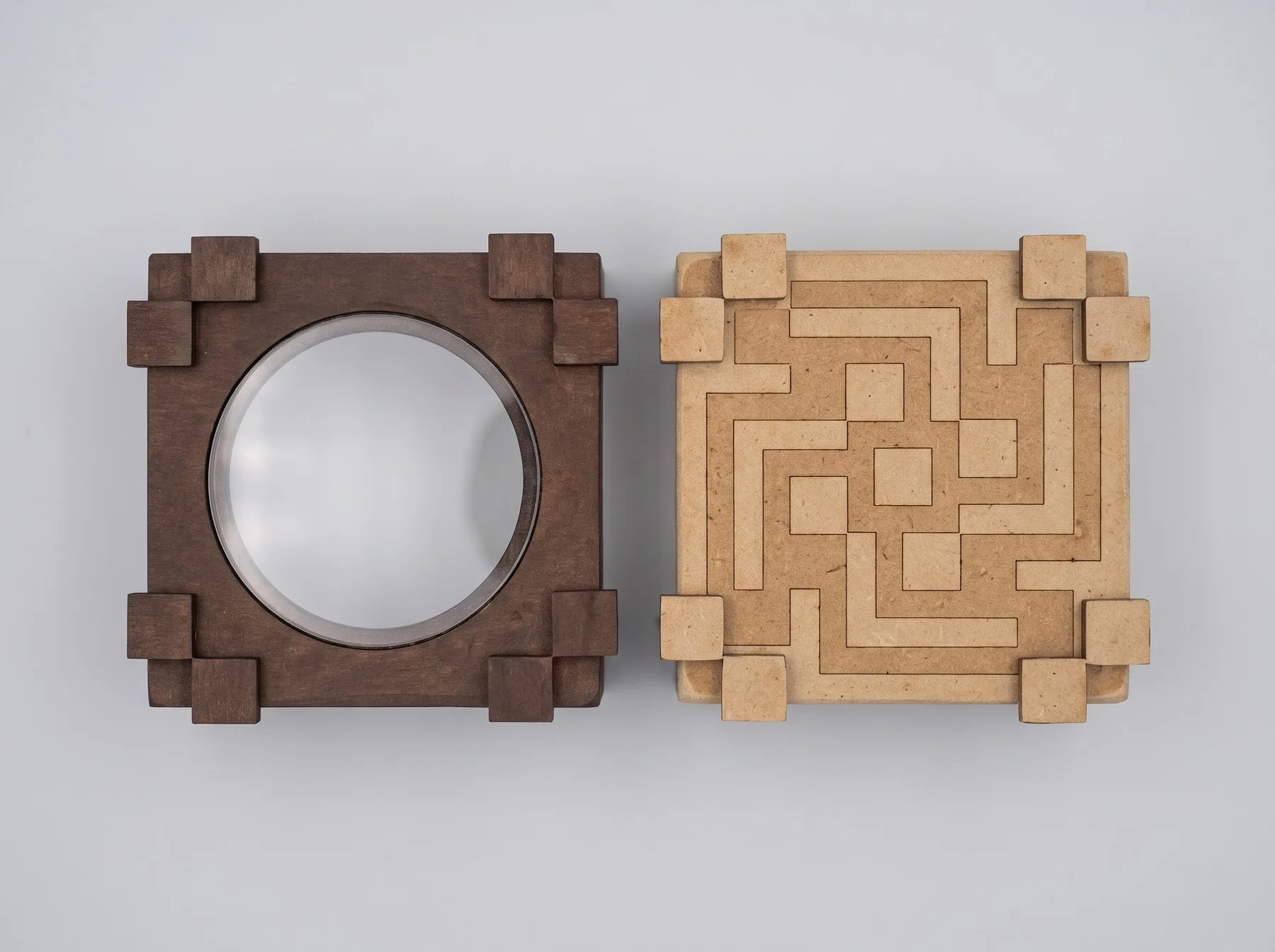
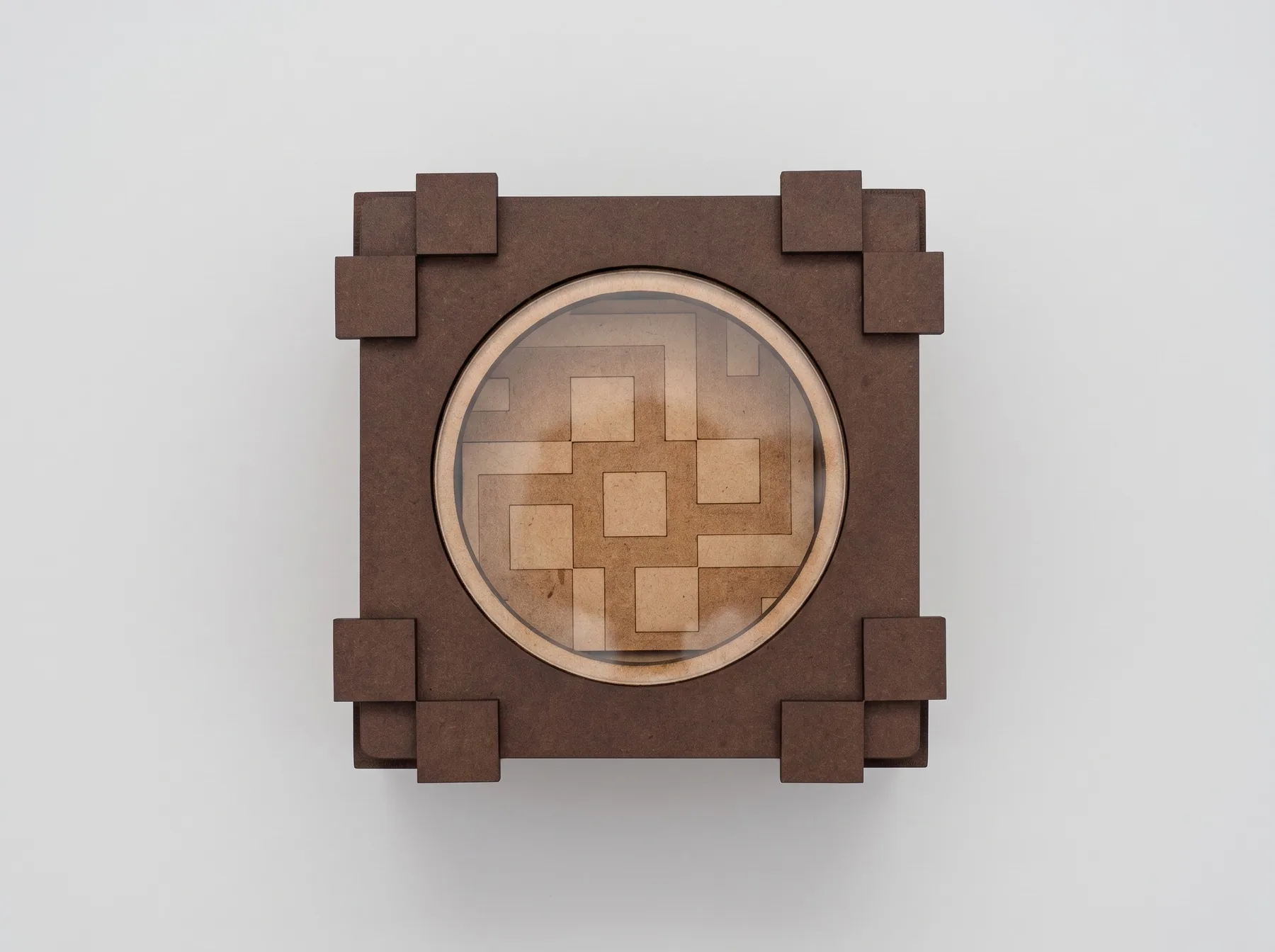
El Umbral is a modular coffee table made of two modules that can swap places. Both share the same structure, but each presents a different surface: one carries a pattern engraved into the wood, the other a circular opening filled with glass.
The intent was to work with reversibility. Rather than fixing one correct way to use the table, the two modules can be exchanged to produce two configurations — which element ends up on top is the user's decision.
The project was developed as a 1:5 scale model in MDF, laser cut and engraved, from a 3D model where dimensions, joints and contact points were verified before fabrication.
The threshold between wood and glass
The name comes from the idea of a threshold as a point of transition between two spaces: a place that belongs fully to neither, but connects them.
That idea reaches the object through two faces. One relates to wood, texture and the travel of the pattern; the other to glass, transparency and emptiness. With the pattern on top the table reads as solid and closed; with the glass on top, open and light.
The reference to the lagoons and to Muisca culture is a connection to territory: in the Cundiboyacense highlands the lagoons held an important place in belief and ritual, and Guatavita is tied to the offerings that later gave rise to the El Dorado myth. The project does not represent those rituals — it takes from them the idea of passage between two worlds.
The project in four steps
- 01
Pattern study
Digitising the graphic derived from Antonio Grass and fitting it to a 0.5 cm grid.
- 02
3D modelling
Verifying dimensions, joints, frame centring and the stacking of both modules.
- 03
Cut and engrave
MDF parts laid out on tabloid format; laser cut and engraved in a single pass.
- 04
Assembly and test
Gluing frame and legs, checking the stops and both configurations.
02 Process
Reference to Antonio Grass
The pattern on the wooden face comes from exploring geometries associated with pre-Columbian graphics and with Antonio Grass's work. He studied and reinterpreted forms present in pre-Columbian iconography, carrying them into contemporary geometric compositions.
No specific piece was copied for El Umbral. The intent was to study resources — lines, modules, repetitions, steps and geometries — in order to build an original pattern.
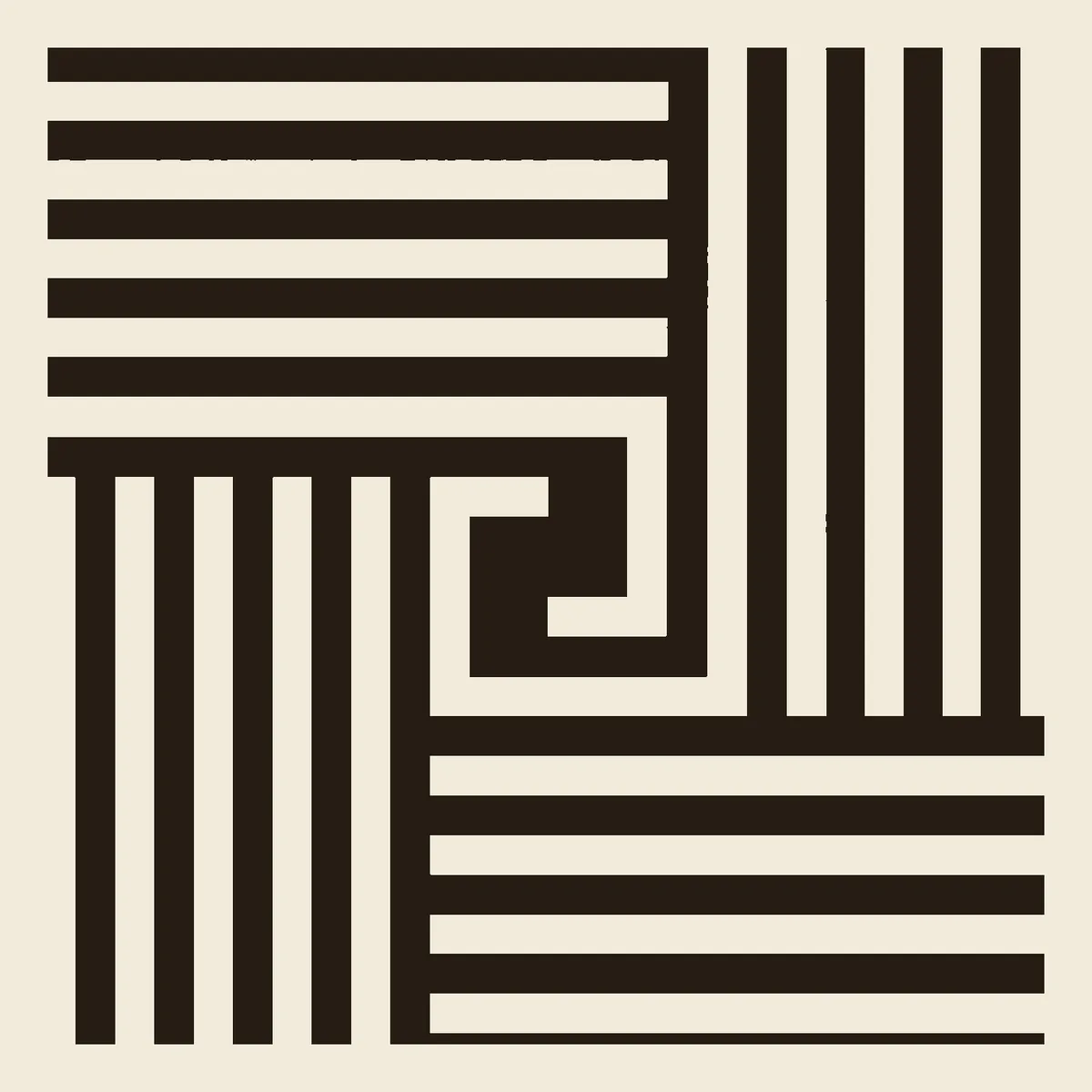
That study produced three engravings. The first two were tested directly on MDF: one orthogonal, one radial. The third, refined, is the one that stayed on the final piece.
The radial version had a more direct relationship to some pre-Columbian forms, but was discarded because it did not speak to the orthogonal structure of the table.

From sketch to grid
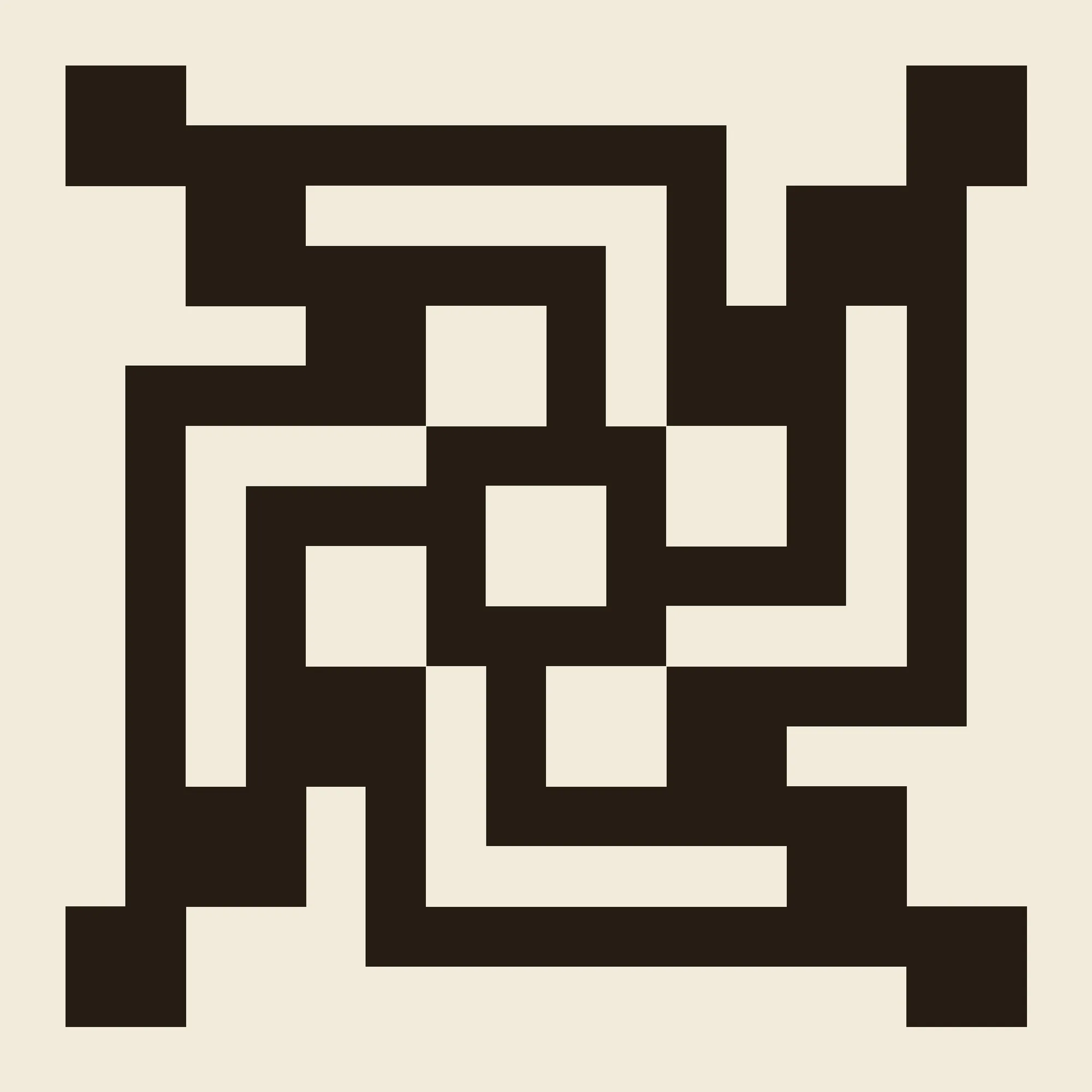
The main lines were identified first and the drawing organised on a grid. From that base the paths and repetitions were adjusted until the composition came out cleaner.
The final pattern works at 0.5 and 1 cm on the model — 25 and 50 mm on the real product — and holds right angles throughout.
- Grid 16 × 16 cells
- Cell 0.5 cm model / 25 mm real
- Area 8 × 8 cm / 400 × 400 mm
From first engraving to final
The final engraving starts from the first (Fig. 2.1), but rewritten onto the geometry of the furniture itself: line width was taken to the thickness of the supports and legs — 60 mm on the real product, 1.2 cm on the model — and the breaks were aligned to the same grid that orders the frame and the stops.
That change in thickness also solved a fabrication problem: the thin lines of the first version burned unevenly on MDF, while the wide stroke engraves clean and reads from a distance. The pattern stops being a drawing applied to the surface and becomes an extension of the measurement system the table is built with.
Construction system
Each module works as an independent piece, made of a top board, a lower frame and four legs.
The board measures 410 × 410 mm with 45 mm thickness. Below it sits the frame — the «madre» — at 430 × 430 mm, which receives the four legs. Each leg has a 60 × 60 mm section and a height of 110 mm.
The structure was designed so the legs stay contained within the frame without significant displacement. Parts are joined by gluing, avoiding visible hardware.
To stack the two modules, small stops were added at the corners of the upper face. These stops reproduce the space that exists inside the lower frame: when a module is placed on top, its legs fall into that space and both bodies stay centred.
The joint between modules does not need to be permanent: it relies on weight, fit and the geometry of the parts.
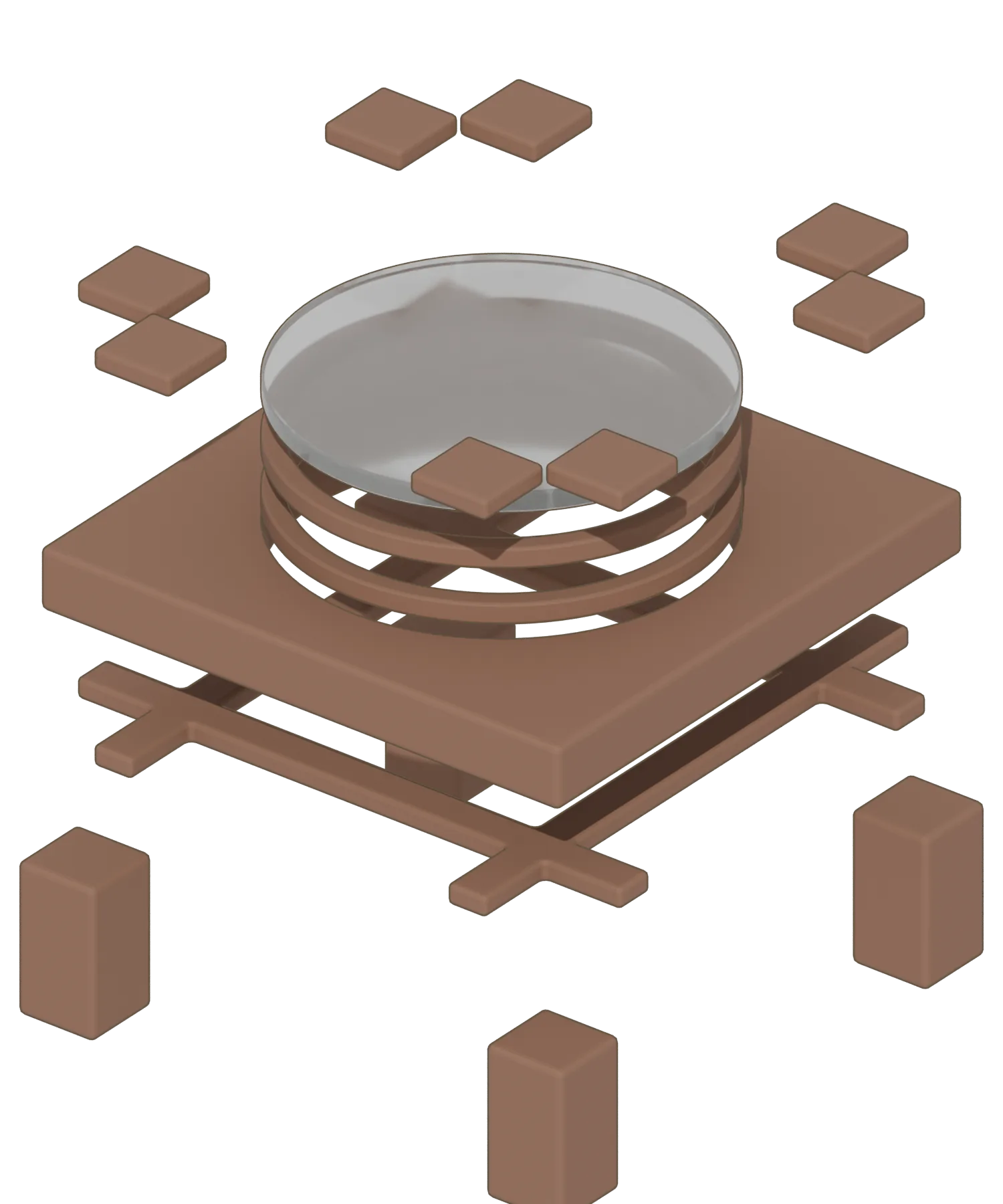
Parts of one module, top to bottom
- 8 corner stops · 60 × 60 × 15 mm
- 1 glass · Ø 300 mm
- 1 upper ring · Ø 300 / Ø 270 mm
- 1 lower ring · Ø 300 / Ø 270 mm
- 1 board · 410 × 410 × 45 mm
- 1 «madre» frame · 430 × 430 × 15 mm
- 4 legs · 60 × 60 × 110 mm
The two rings are glued one on top of the other inside the board's opening and form the platform the glass rests on, flush with the upper face.
System logic
- 1 · Board — defines the visible surface of each module: engraved pattern on one, glass window on the other.
- 2 · Frame — works as structure, receives the legs and keeps a rigid joint with the board.
- 3 · Legs and stops — let the module rest on the floor and receive the second module on top, without hardware.
The two modules are practically identical in structure and differ only in the surface they present.
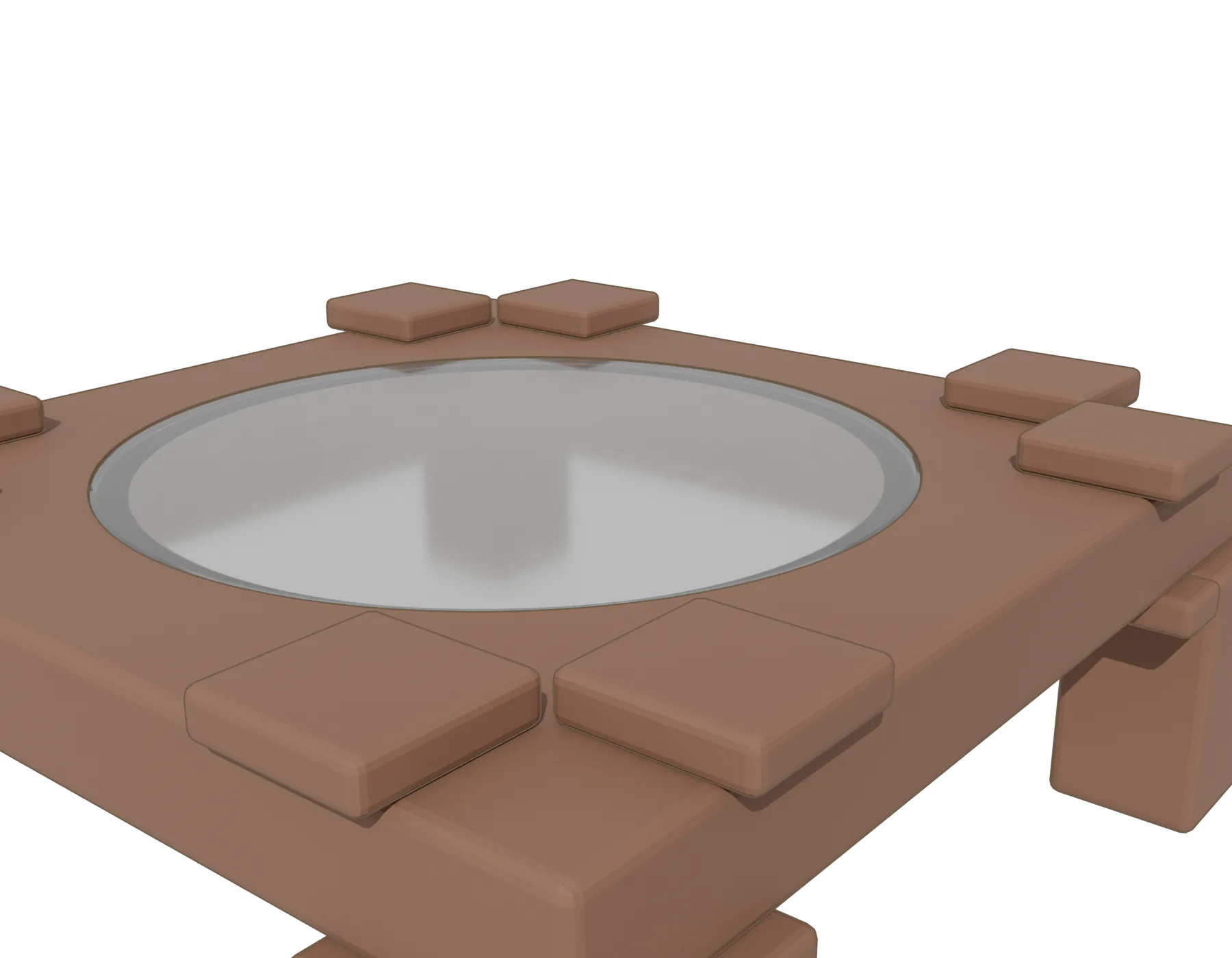
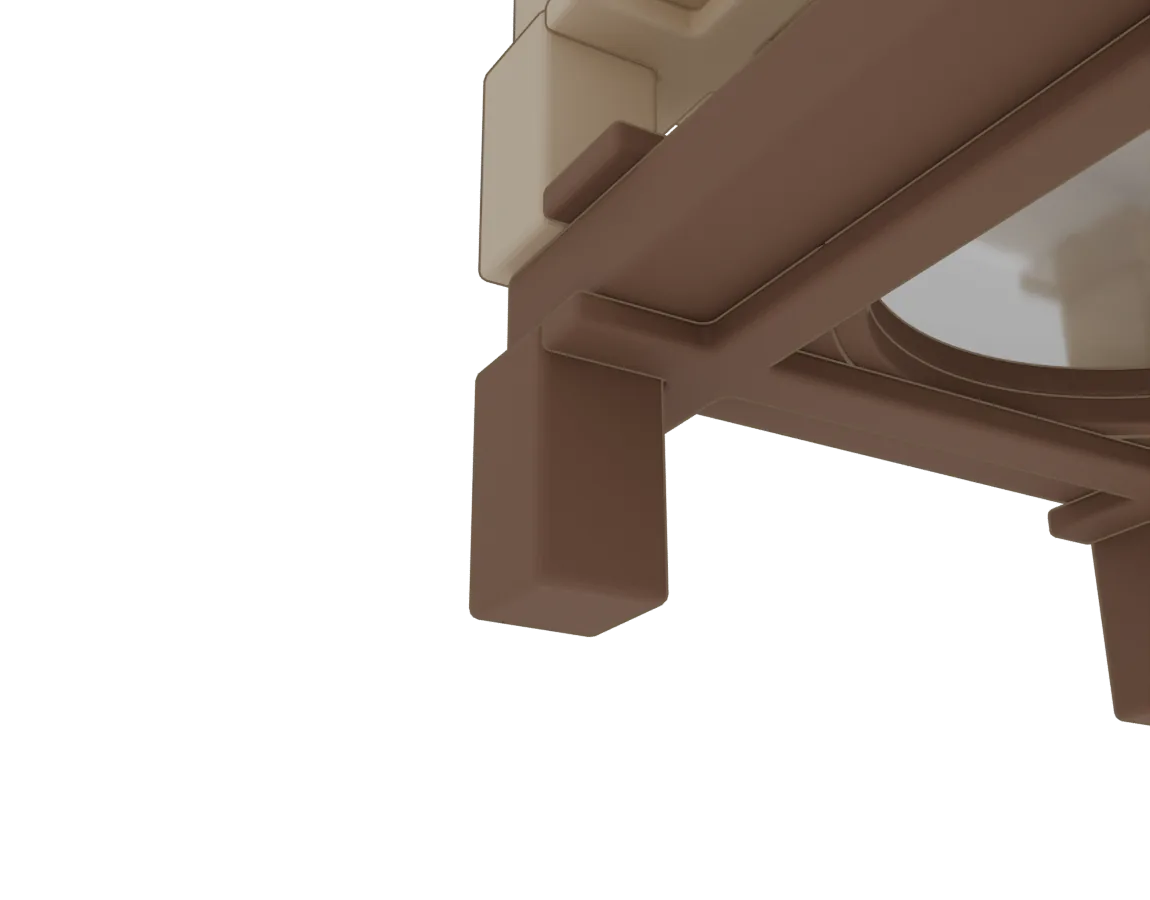
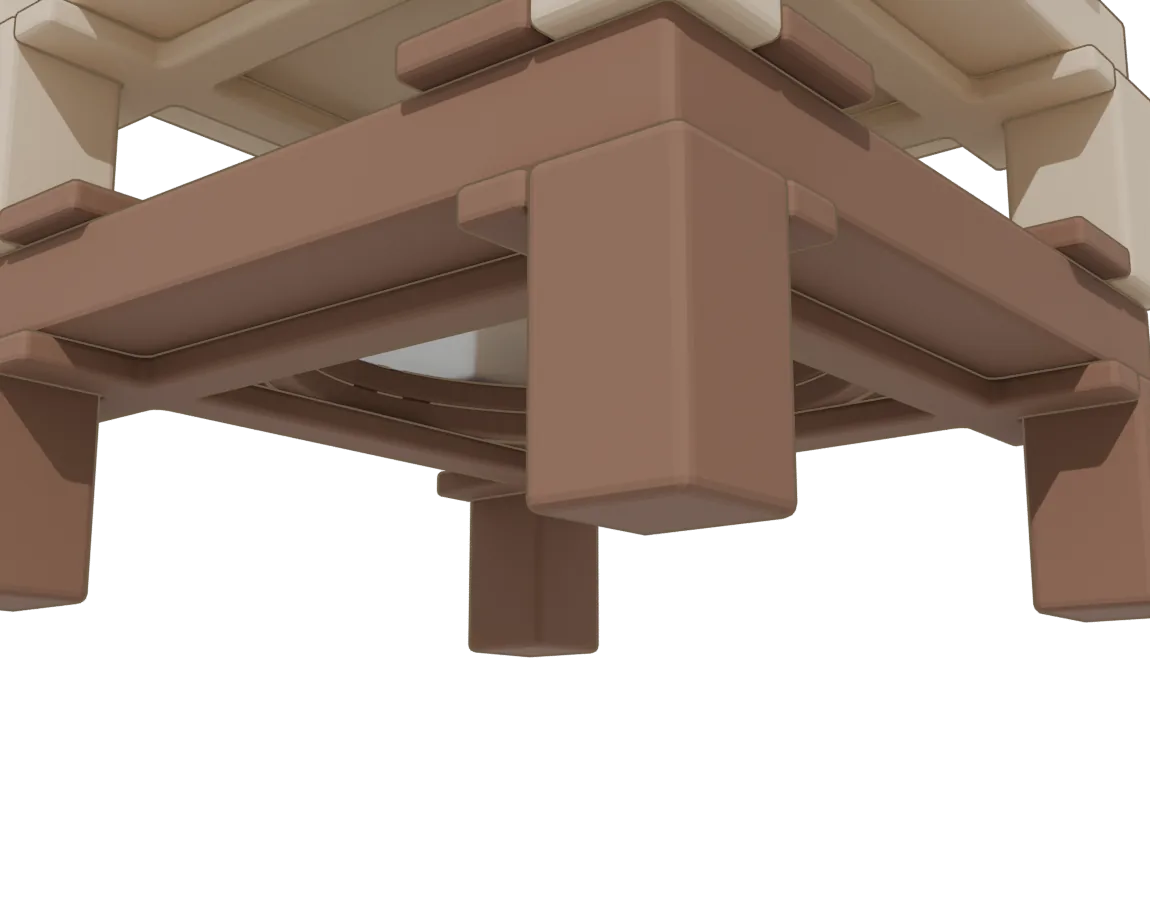
Stacking works because the geometry repeats: the corner gap of the frame below and the pair of stops above have exactly the same measure as the leg section (60 × 60 mm).
03 Decisions
Views & Dimensions
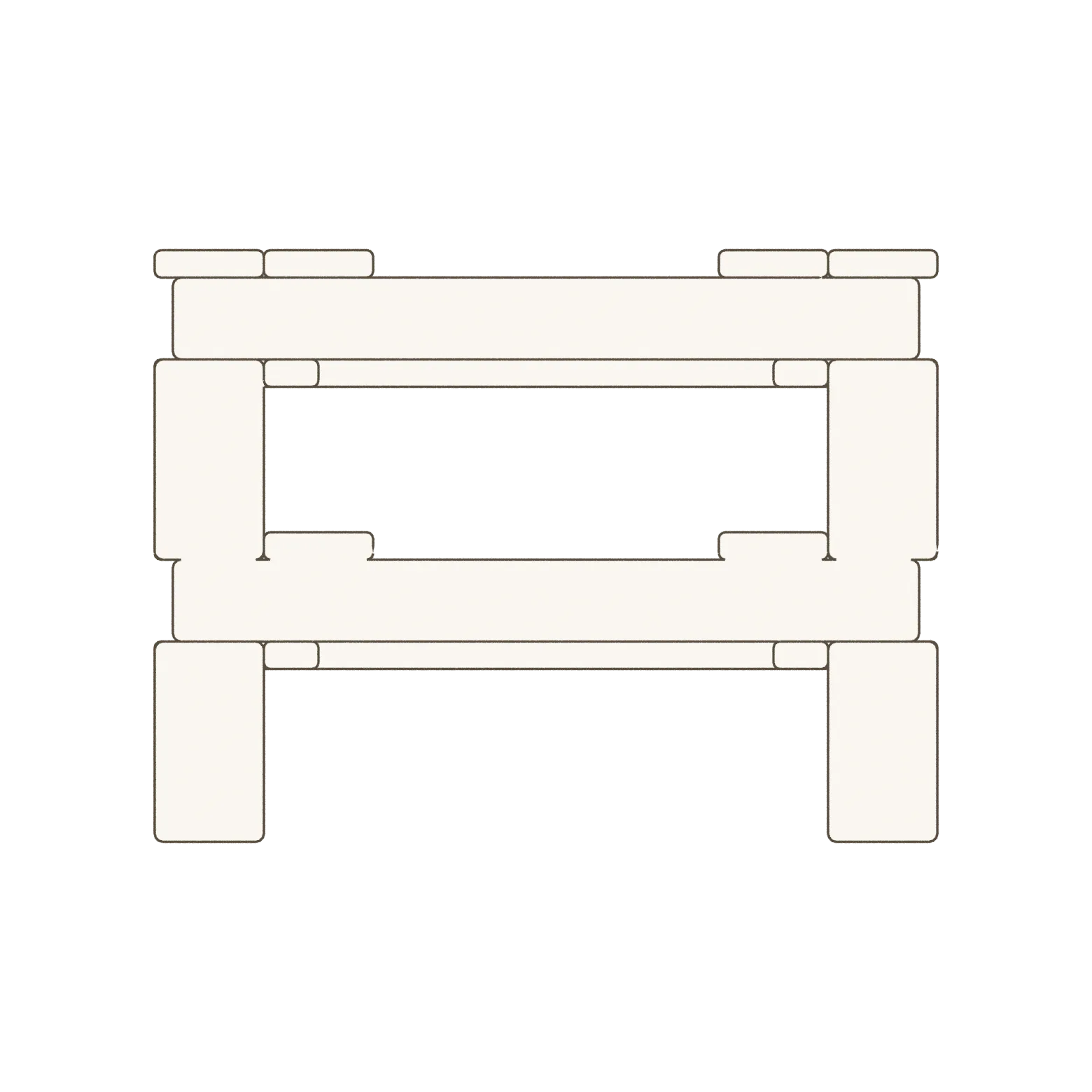
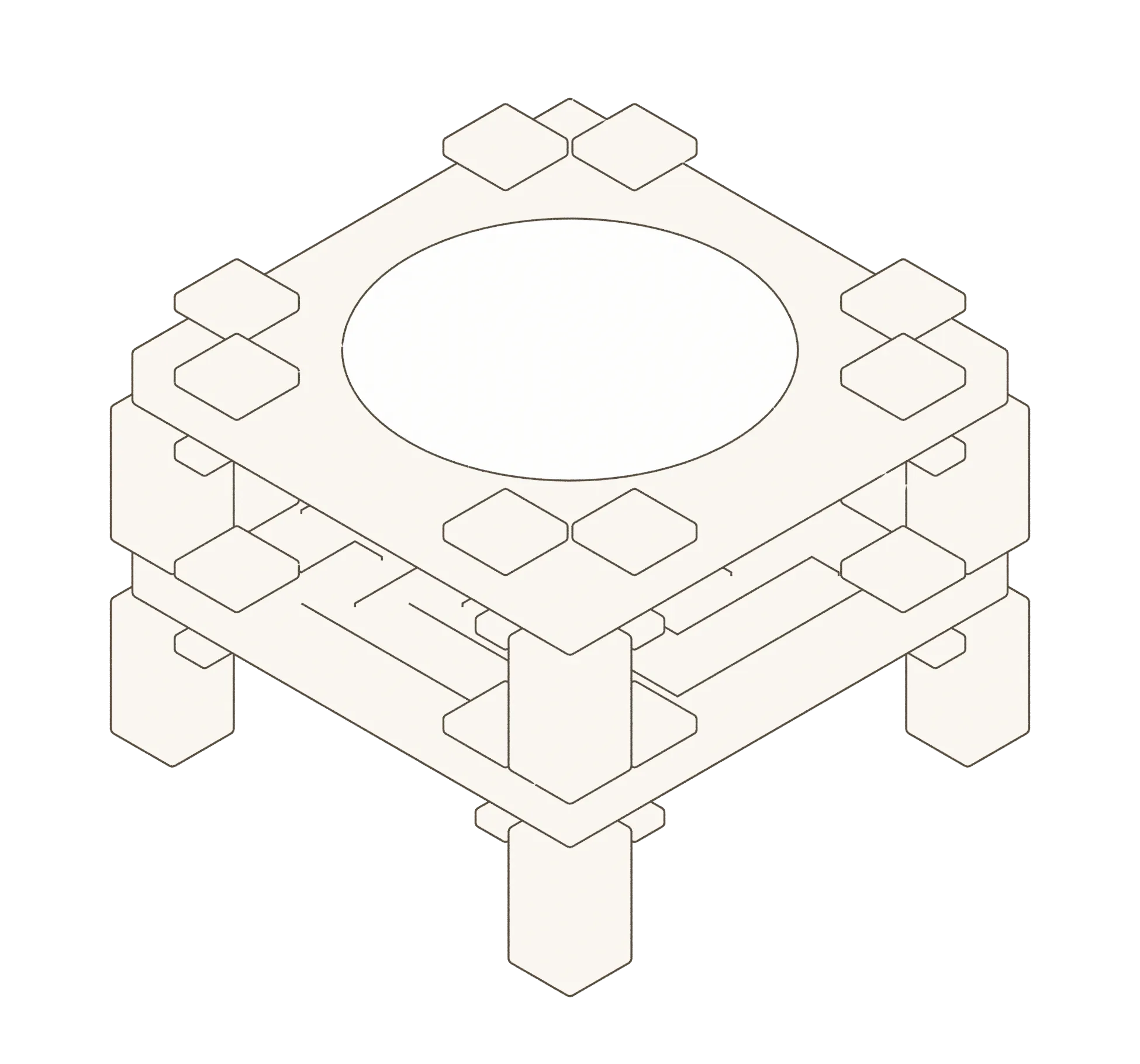
The views on this sheet are drawn at 1:5 over the verified 3D model: each part occupies on paper exactly what it occupies on the model. Dimensions indicate real product measures, in millimetres.
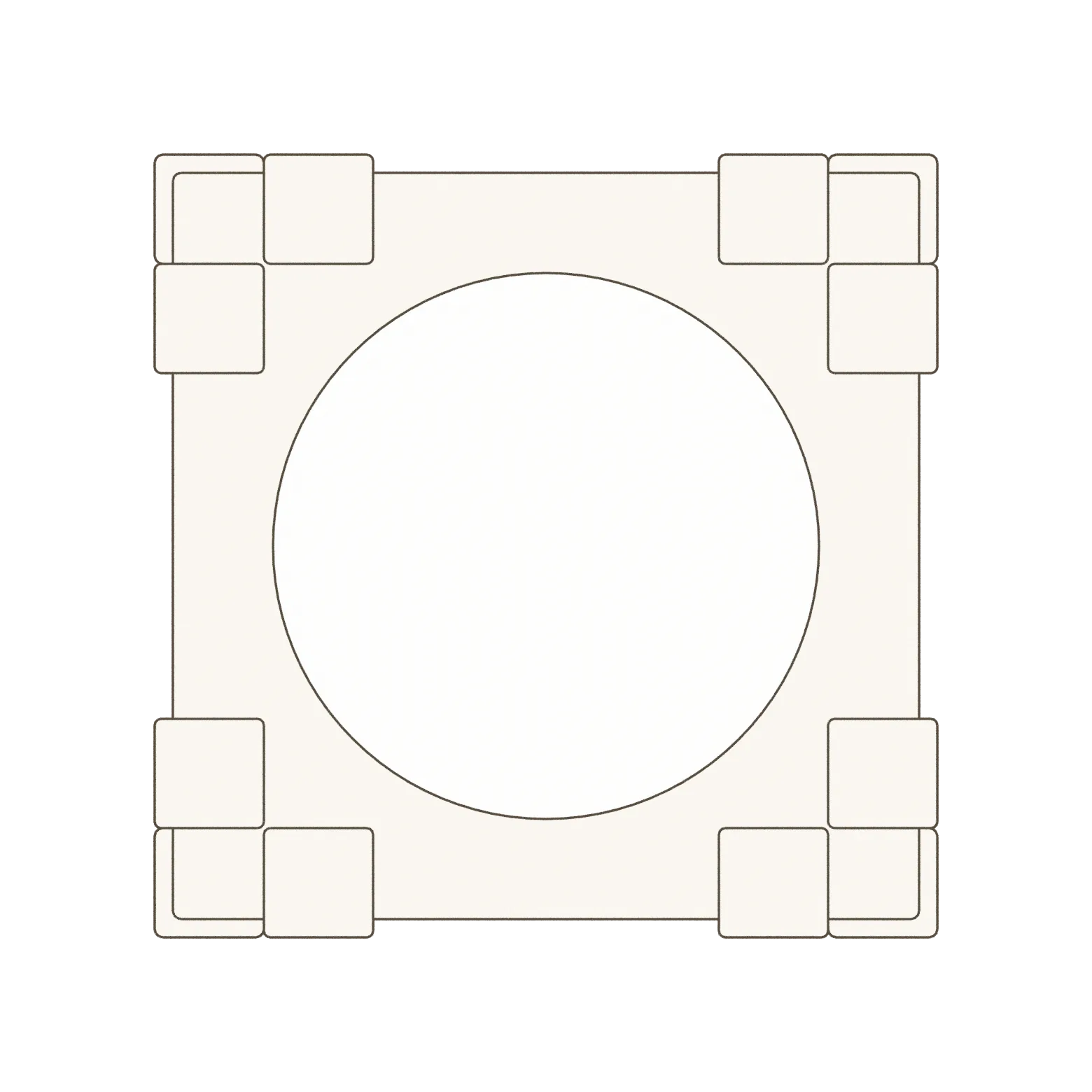
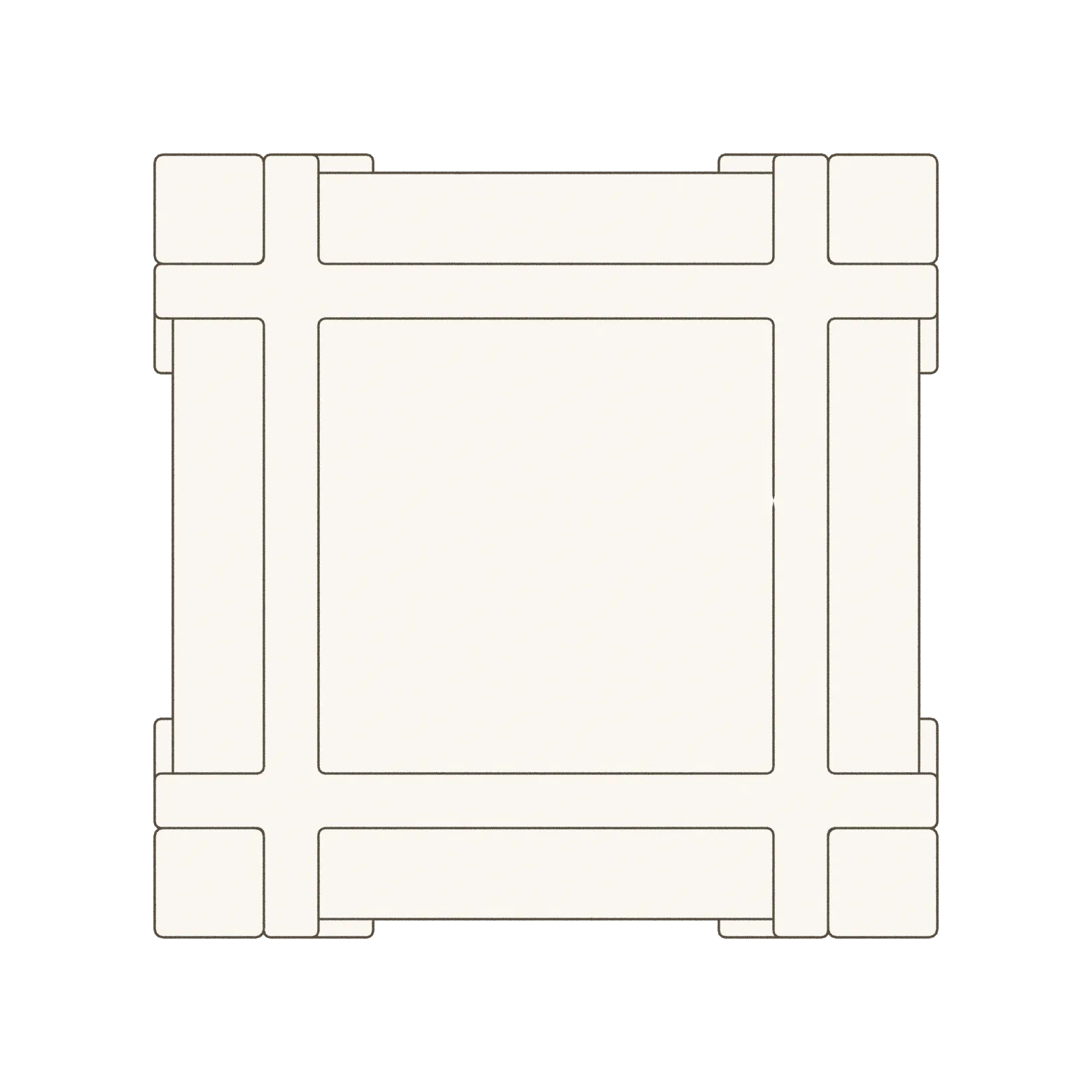
General dimensions · real product
- Board — 410 × 410 × 45 mm
- Frame («madre») — 430 × 430 × 15 mm
- Legs — 60 × 60 × 110 mm
- Corner stops — 60 × 60 × 15 mm
- Window — Ø 300 mm (inner ring Ø 270 mm)
Height of one module — 155 mm Total height, two modules stacked — 310 mm
Notes
- The model was built at 1:5 scale in MDF, with 4.5 mm boards and 1.5 mm fine parts, equivalent to 45 and 15 mm on the real product.
- The legs stay contained in the corner gap of the frame; the upper stops repeat that same gap on the board to receive the module stacked above.
Configurations
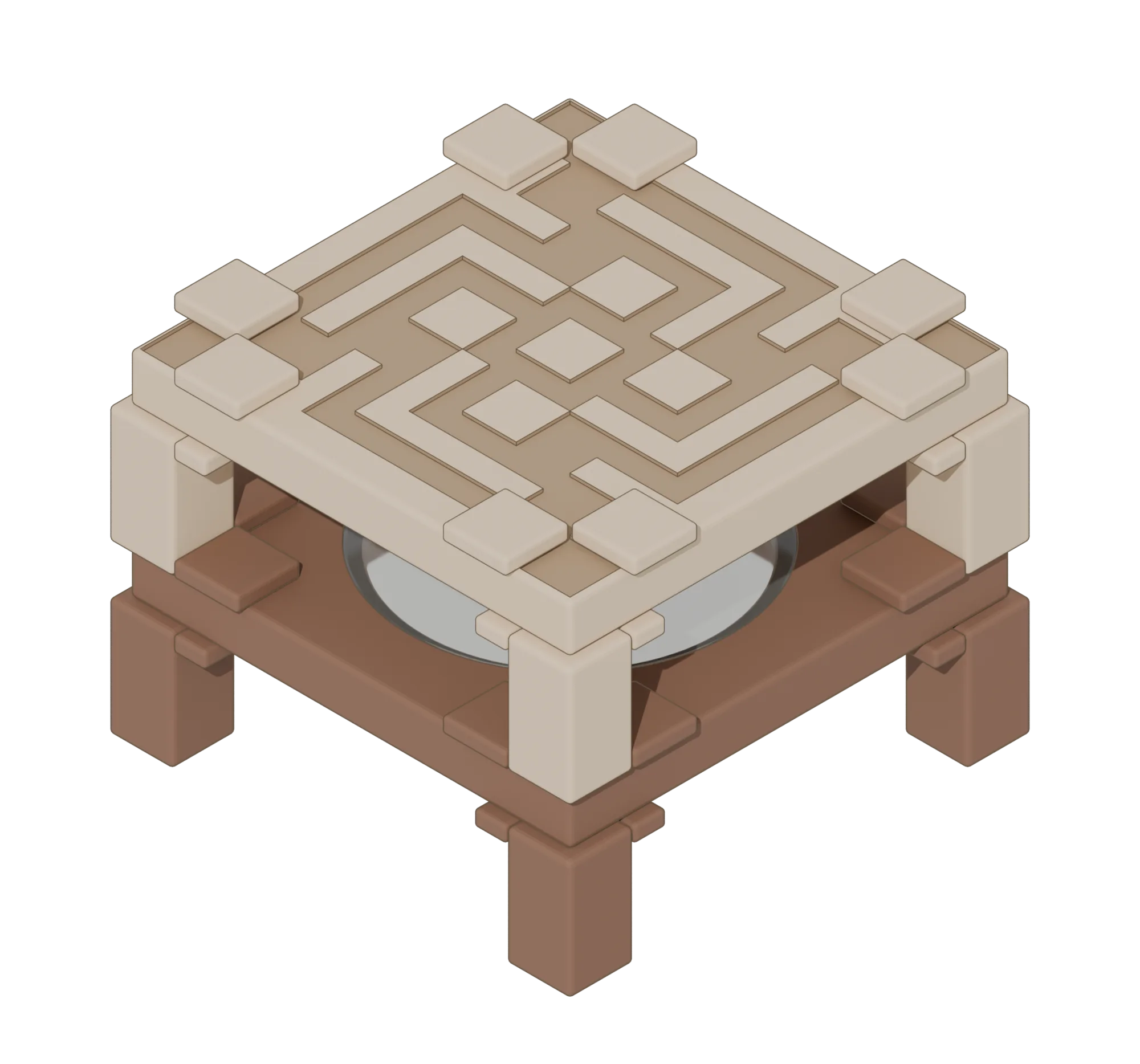
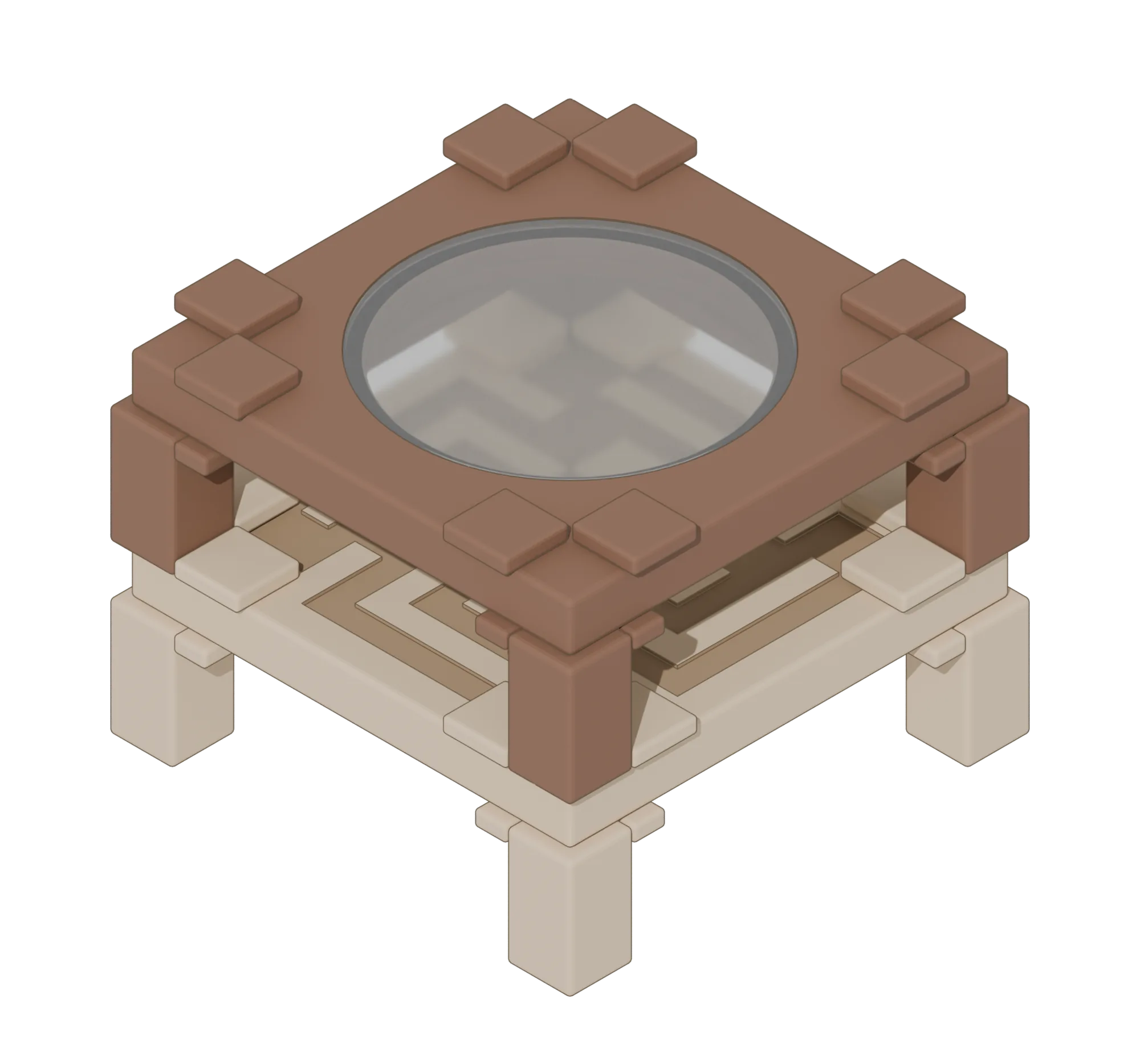
The two modules are interchangeable. Changing which one is on top does not modify the structure or require tools: you lift one module and rest it on the other, fitting the legs into the corner stops. Each configuration changes the character of the table and the kind of use it favours.
Configuration A · pattern on top
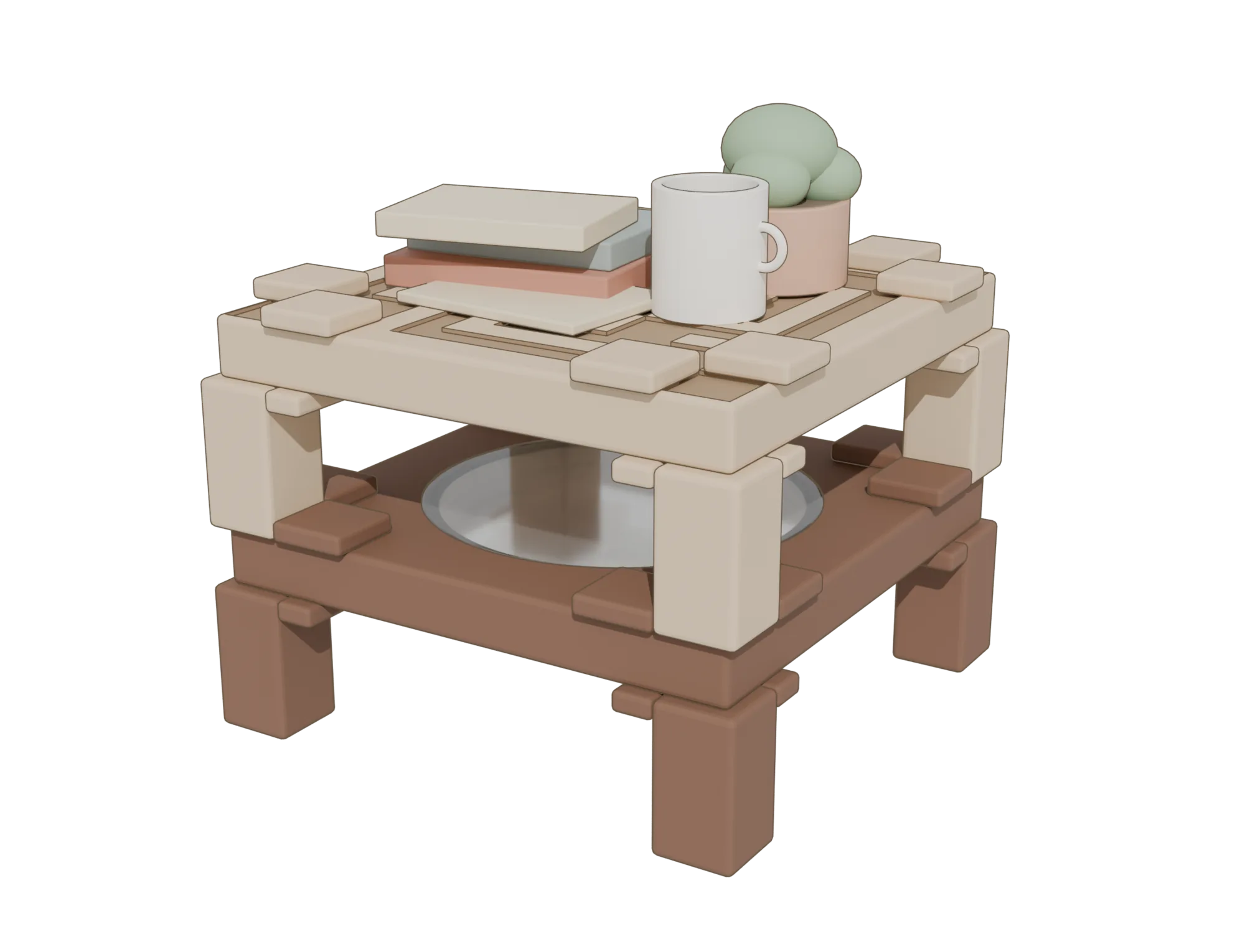
The module with the engraved pattern sits on top. The surface is continuous and wooden, with greater visual presence, and the whole reads as more solid and closed.
It favours use as a permanent resting surface: trays, books, cups or a remote. The lower level, with the window, stays as visible storage.
Configuration B · glass on top
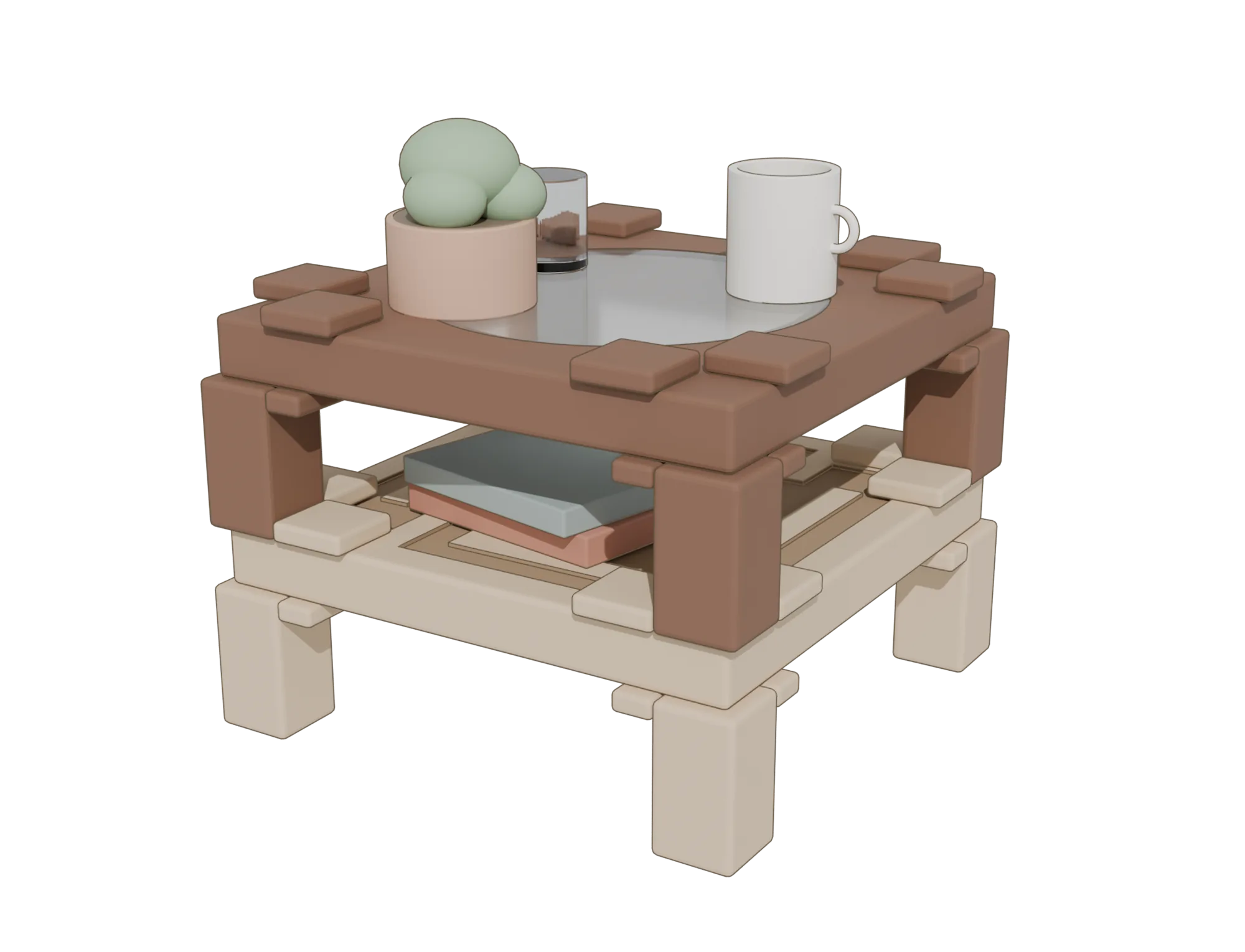
The module with the circular window sits on top. The opening becomes the main element, reveals the lower level and visually lightens the whole.
It works when the table acts as a display case: whatever is stored below is exposed through the glass. The surface is also easier to clean.
04 Result
In Use
Both configurations set with everyday objects for a coffee table: books, tray, cup and a small plant. The scenes were built with the same 3D model and at the same scale, to check the relationship between the furniture and the objects it holds.
Physical prototype
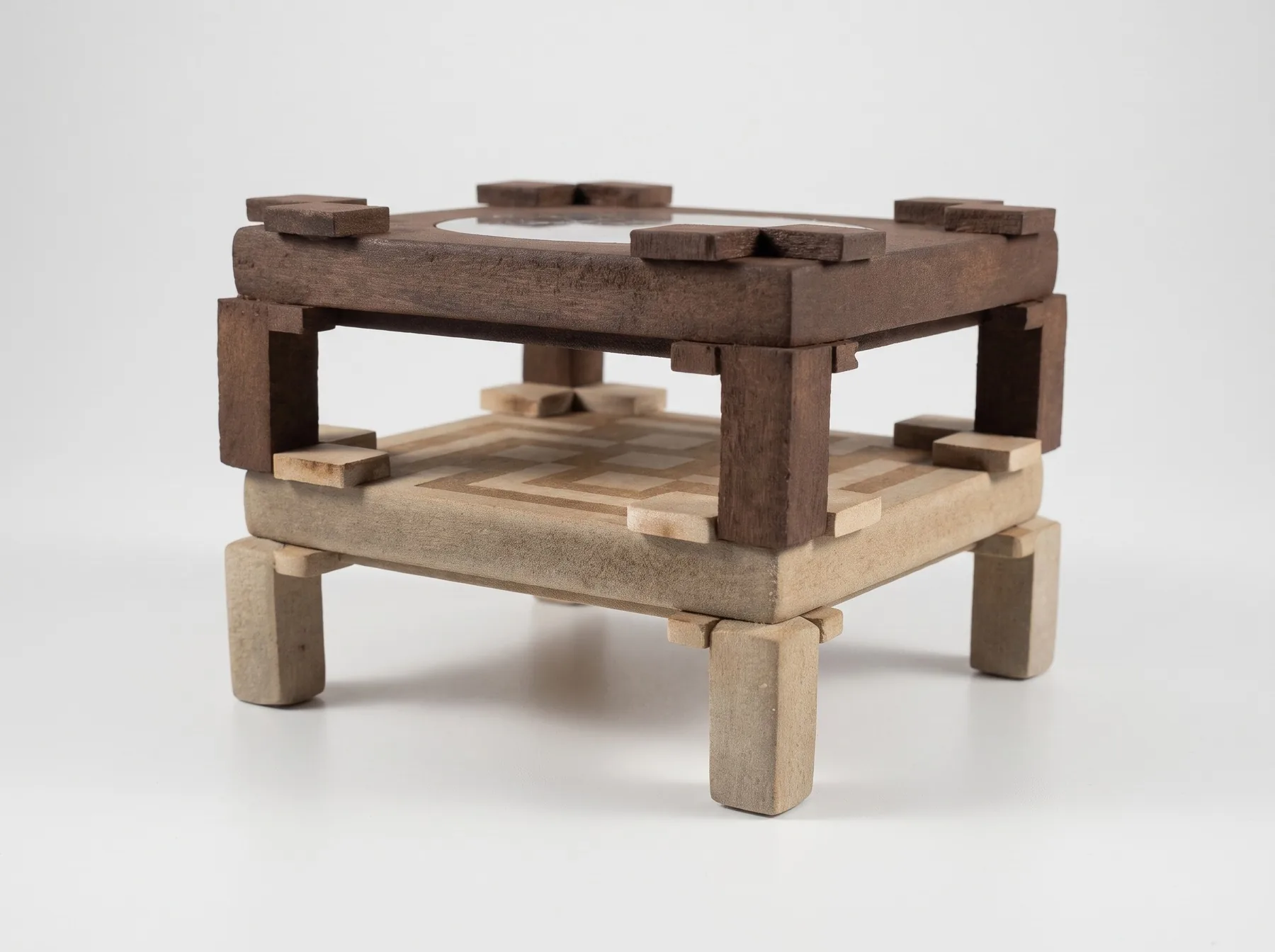
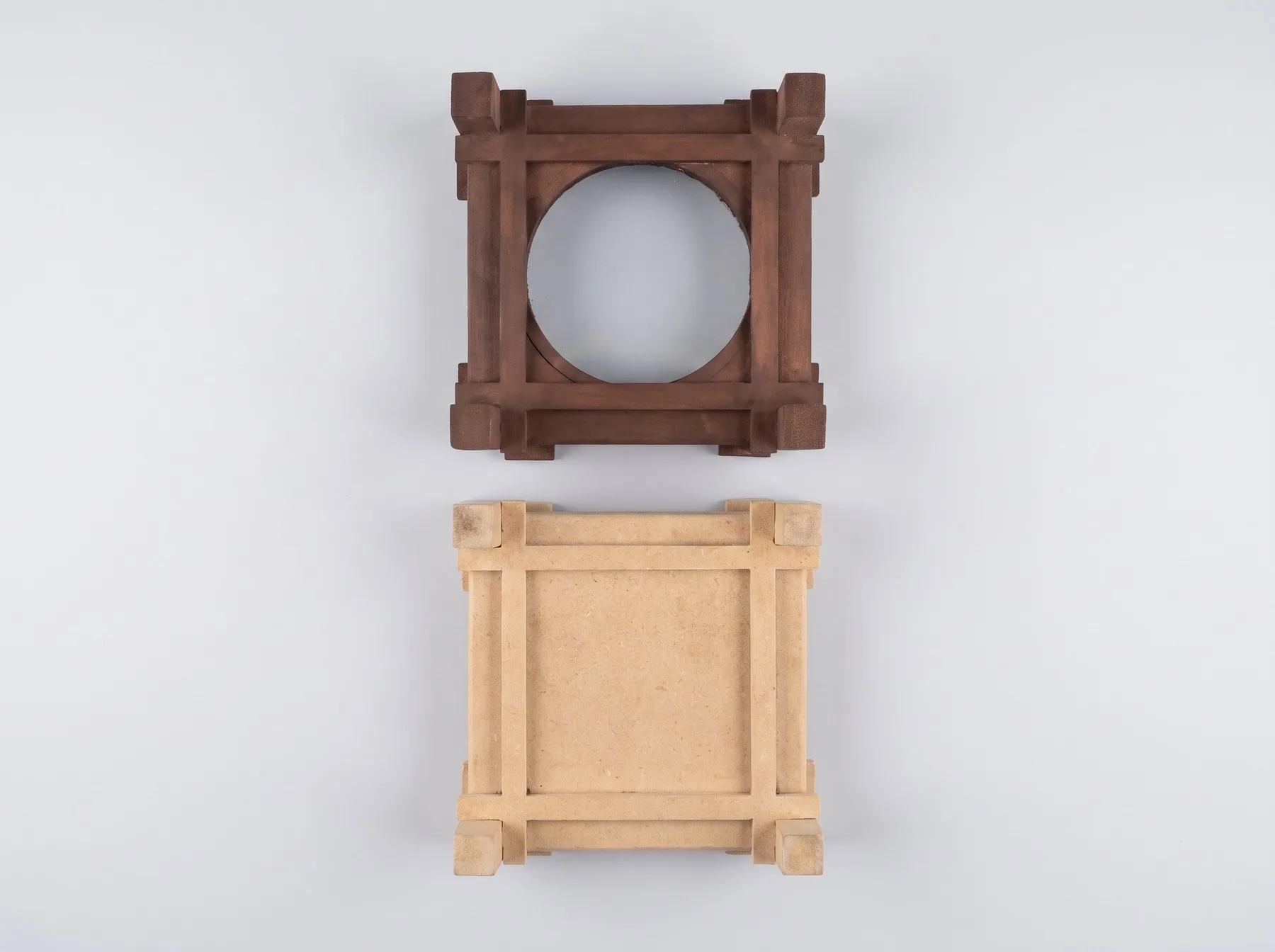
The prototype made it possible to physically verify the decisions taken during digital modelling.
Cutting and assembly allowed a review of the frame dimensions, leg position, how the stops perform and the relationship between the two modules.
It also helped identify adjustments before defining the final version: the exact position of the stops was corrected from what the model revealed.
What was verified
- Leg fit in the corner gap of the frame
- Frame centring against the board
- Stacking and centring of both modules
- Legibility of the engraving on MDF
- Stability of the assembled whole
1:5 scale model · 4.5 and 1.5 mm MDF · laser cut and engraved · glued joints.
On the photographic record
The original shots were taken in the workshop, on the cutting table and with measuring instruments in frame. For this memoir they were processed digitally: background and extraneous elements were removed, and the four photographs were brought to a single neutral surface and a single lighting. The aim is to be able to compare the parts and read the construction system without distraction.
Project data
- Typology — Modular coffee table
- Materials — MDF · glass / acrylic
- Dimensions — 410 × 410 × 310 mm
- Modules — 2, interchangeable
- Fabrication — Laser cut and engraved · glued joints
- Model — 1:5 scale
Next case